

Lifesaving Treatment Leads to a Career Driven by Compassion and a Gift for Future Physicians
Gary Salzman, MD, and his wife, Lili, seek to express their gratitude through a planned estate gift to the institution that gave them so much
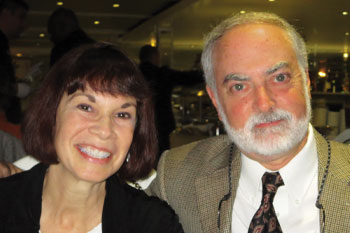 By Laura Lane-Garavaglia
Gary Salzman, MD, can trace some of the most important chapters of his life back to Rush.
It’s where he trained as a young medical student and began his career. It’s where he met his wife. It’s where he nearly lost his life. And it’s where he was given the chance to begin again.
“Rush saved my life, allowed me to meet my wife and provided me with the framework and tools necessary to pursue a successful career as a geriatrician,” Dr. Salzman said.
Now, through a planned estate gift, Dr. Salzman and his wife, Lili, are ensuring that the institution that shaped his life will continue shaping the future of geriatric medicine.
A diagnosis and lifesaving care
In 1990, Dr. Salzman, then 37, was an attending physician at Rush University Medical Center when he found himself fighting a mysterious illness that had been worsening for more than a year. As he grew weaker and increasingly short of breath, he was hospitalized at a local hospital for what was believed to be pneumonia. Within days, he could no longer stand.
That was when he transferred himself to Rush.
There, physicians performed a bronchoscopy and discovered he wasn’t battling pneumonia — he was bleeding into his lungs. A kidney biopsy ultimately confirmed a diagnosis of a rare and life-threatening autoimmune disease, which at the time had an extremely poor prognosis.
Three physicians, Roger Rodby, MD, Stuart Levin, MD, and former Rush Medical College dean Henry Russe, MD, quickly identified a treatment protocol developed by Anthony Fauci, MD, at the National Institutes of Health that significantly improved survival rates for the disease.
“They diagnosed me when others couldn’t,” he said. “They found the correct treatment and saved me. Before this protocol, 90% of people with my diagnosis died within a year. After it, 90% went into remission. I was one of the people who improved. They saved my life.”
During his two weeks in intensive care, nurses brought him a chocolate cake on his birthday. A volunteer wheeled him outside into the spring sunshine — a small act he has never forgotten.
It was that compassionate care combined with the most advanced treatments that would shape the rest of his career.
From student to patient to physician
Dr. Salzman’s connection to Rush began years earlier as a medical student in 1973 at Rush Medical College.
He was drawn to the school’s small class size and early clinical exposure. But it was the culture, one that valued patients as people first, that left the deepest impression.
After medical school came an internship, residency and chief residency in internal medicine at Rush. The training was both fulfilling and demanding.
“It was the hardest internship in Chicago,” he said. “But it was the best.”
The rigor paid off. While doing a rotation at Cedars-Sinai in Los Angeles, he realized just how strong his foundation was. Rush had prepared him not just to pass his boards but to lead.
He would go on to serve as a chief resident in internal medicine at Rush, eventually helping launch one of Illinois’ earliest geriatrics fellowship programs. This was monumental at the time because geriatrics wasn’t even a formally recognized subspecialty.
It was also during these years that he met his wife, Lili, then a social worker at the Johnston R. Bowman Health Center at Rush.
For Dr. Salzman, his diagnosis changed him in ways a textbook never could and illuminated his purpose.
“There were moments when I felt like people thought I was exaggerating my symptoms,” he said. “Being a patient taught me what that feels like.”
It reinforced the idea that medicine must be rooted in empathy. When he returned to work after his diagnosis, he did so with renewed clarity: He would dedicate his career to older adults.
Specializing in an area of medicine few choose
When Dr. Salzman began practicing geriatrics in the early 1980s, board certification didn’t exist. Financial incentives were limited. Prestige was minimal. But he saw something others often overlooked.
“Everyone grows older,” he said. “Older patients deserve physicians who are trained to understand their unique physiology, medication tolerance and goals of care. There’s a tendency to write older people off and to assume something is happening just because of age. I never believed that.”
He instead took the time to build relationships and advocate for patients who were too often dismissed.
After relocating to Arizona, Dr. Salzman became the director of geriatric education and of the Internal Medicine Geriatric Fellowship Program at Banner - University Medical Center Phoenix, where he continued practicing, teaching and mentoring.
He trained faculty across disciplines and launched multidisciplinary conferences with leaders in psychiatry, rehab and geriatrics. Dr. Salzman was eventually awarded the first Lifetime Achievement Award for Geriatric Medicine from the Arizona Geriatrics Society.
But his professional accomplishments aren’t what matter most to him. Compassion remains at the heart of his vocation.
“Older people have different needs,” his wife, Lili, said. “They deserve doctors, like Gary, who understand.”
A legacy for geriatric medicine
Today, the Salzmans are ensuring the commitment to quality care for older adults continues.
Through their estate plan, including gifts from their IRA and trust, the Salzmans are establishing long-lasting support for geriatric education at Rush. They are funding a scholarship for medical students and are planning a significant gift to help advance geriatric medicine through an endowed chair.
By making this commitment, the Salzmans have joined the Rush Heritage Society, a community of donors who have committed to sustaining Rush through their estates.
Their motivation is both practical and deeply personal.
The couple does not have children — a consequence of the lifesaving treatment Dr. Salzman received. But, throughout his career, he has viewed his students and trainees as an extension of his legacy.
“I’ve trained hundreds of residents, students and fellows,” he said. “If Lili and I can help educate even more physicians to properly care for older adults, that matters.”
An endowed position in geriatric medicine would do more than carry their name. It would help recruit strong leadership, expand fellowship training and ensure that geriatrics remains a visible, valued discipline at Rush.
“In some places, geriatrics disappears because it isn’t seen as profitable,” Dr. Salzman said. “But it’s essential. These patients deserve the best care and compassion, and we want to make sure it continues here at Rush.”
Lili agrees.
“I want him to be remembered for his entire career dedicated to providing for older patients,” she said, “Helping to shape future generations of physicians through this gift is just one of the ways we can do that.”
Their estate gift will help carry on that legacy, ensuring that future physicians at Rush are prepared to not only treat disease but also honor the dignity of aging.
To learn more about gift planning or discuss options that might be right for you, please contact Susan Sasvari, executive director of gift planning, at (312) 942-3691 or giftplanning@rush.edu.
© Pentera, Inc. Planned giving content. All rights reserved.
Disclaimer